The Lantern at Robert's Grave
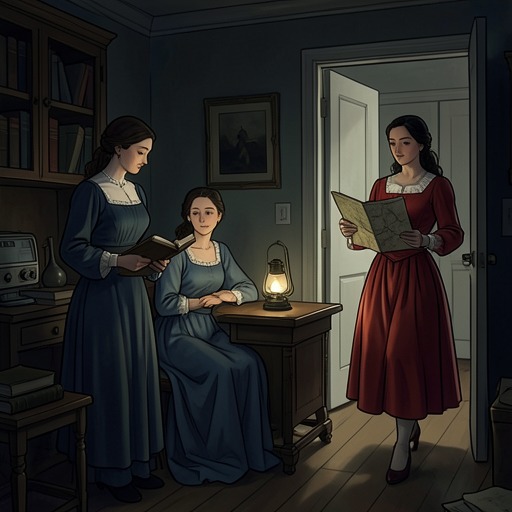
The StaircaseThe Lantern at Robert's Grave is the light Violate Lacey leaves beside the grave of her son, Robert Lacey, in a small stone shelter at Fort Marcy. It is at once a practical object repeatedly lit and a private memorial shaped by grief: Violate visits the grave daily, and when illness prevents her from going, Lizzy Enders takes over the task. Its return at the end of Lizzy's visit, still set upright and burning after an assault, links ordinary acts of care to the story's sudden violence.
Setting and Form
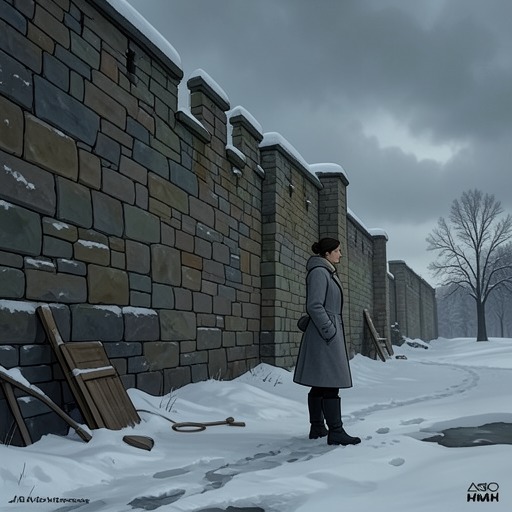
The lantern stands inside a small, cave-like structure made of stones beside Robert's listing headstone. This arrangement places the light within a sheltered space at the grave's edge, rather than leaving it exposed on the ground. The shelter is modest and handmade; the lantern's significance comes not from any stated special power but from its location and continued use. It marks the grave as a place that Violate returns to, and makes that private act visible when someone comes upon her there.
The cemetery first enters this episode through darkness, mist, bones, and the uneven headstone. Lizzy and Ben follow a cry uphill and find Violate kneeling before Robert's grave. When Violate notices Lizzy, she reaches for the lantern and holds it in front of her before asking the stranger to go away. In this encounter the object is both the light beside her son's grave and the thing she grasps as she confronts an unexpected visitor. Its ordinary material presence anchors a scene in which Violate's understanding of who is present is not always reliable.
A Practice of Mourning
Violate explains that Robert was her only son. She comes to the grave every day to leave flowers and leaves the lantern there for the night; sometimes she also brings food from the kitchen. On the occasion when Lizzy finds her, Violate has fallen asleep at the grave and remained there until morning, something she says has never happened before. The lantern belongs to this repeated pattern of tending: it is left in place after the visit, extending her attention to the grave into the night.
The account gives the object a particular intimacy without turning it into a supernatural instrument. Violate speaks to her dead son and says he did not mind that she fell asleep there. Her words place the lantern within an ongoing relationship enacted through return, flowers, food, and nighttime vigil. The grave's small stone shelter, with its light inside, is the material setting for that routine. When Violate describes Fort Marcy as a place where ghosts and other beings may be found, the lantern remains one concrete element of a landscape that Lizzy experiences as both unsettling and real.
Lizzy Takes Up the Task
Later, neuralgia has weakened Violate, so she asks Lizzy to act as her emissary. Along with a shawl for Delvina and a folded note intended for Jesse James, she gives Lizzy an instruction to leave the note beneath a stone on top of the structure that holds the lantern. She also tells Lizzy to make sure her son's lantern is lit. The request brings two separate duties to the same spot: the secret message must be placed where it will not blow away, and the memorial light must be renewed.
Lizzy doubts that Jesse James is anywhere near Fort Marcy, but promises to carry out Violate's instructions. On a cold day she rides Ben to the old fort with a new candle and matches. At Robert's grave she puts the note beneath a rock, then kneels to replace the candle in the lantern. These details make the errand more than an abstract act of loyalty: Lizzy has to bring the supplies, find the grave, secure the note against the wind, and tend the light. Her care for Violate is expressed through this practical continuation of a ritual Violate cannot perform herself.
The Lantern After the Attack
While Lizzy is kneeling at the grave, a man rushes at her and demands to know where his wife is. A shot rings out; Lizzy is struck down and loses consciousness. When she wakes, the attacker is gone. Blood and marks of a struggle remain on the stones and sand, and the note for Jesse James has disappeared. Beside these signs of disruption, the lantern has been set back upright at Robert's grave, its new candle lit, with the matches left nearby.
The scene does not explain who restored the lantern or what became of the man. It does, however, distinguish the aftermath of the attack from the task Lizzy had begun: the note is gone, the ground bears evidence of violence, but the grave light has been put in order and left burning. The lantern's continuity is therefore concrete rather than miraculous. It records the completion, by someone, of an act of tending even as the assault interrupts Lizzy's visit. Repeatedly passed from Violate's care into Lizzy's hands, it joins mourning and obligation to a moment when the cemetery becomes dangerous.